If someone sends you “WTV” in a text, chat, or social media message, they usually mean “whatever.” It is a casual abbreviation used when someone does not care about a choice, wants to dismiss a topic, or feels that an argument is not worth continuing.
For example, “WTV, you decide 😂” can mean “Whatever, you decide.”
People often search for wtv meaning in text because abbreviations can be confusing, especially when tone is hard to read online.
You may see WTV in texts, group chats, comments, or apps such as WhatsApp, Instagram, TikTok, and Snapchat.
In this guide, you’ll learn what WTV means, how people use it, whether it sounds rude, and how to reply naturally in different situations.
What Does WTV Mean in Text & Chat?
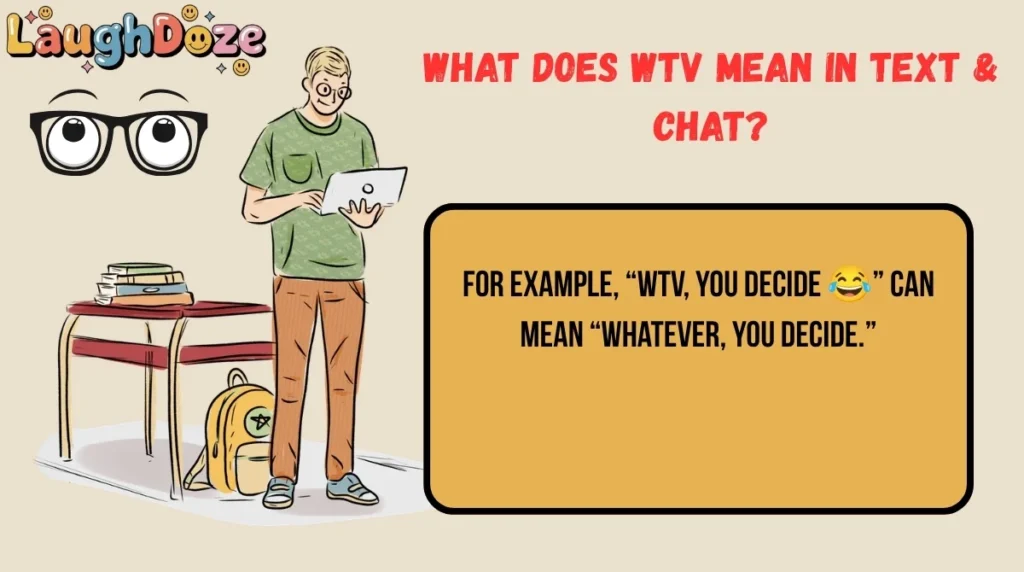
WTV usually means “whatever” in text and online chat.
It is a shortened form of the word “whatever.” People use it to express indifference, dismissal, acceptance, or sometimes mild annoyance.
For example:
“WTV, I’m okay with either one.”
This means:
“Whatever, I’m okay with either one.”
The exact tone depends on the conversation. WTV can be completely casual and harmless between friends, but it can also sound dismissive if someone uses it during an argument.
Full Form, Stands For & Short Meaning of WTV
The common meaning of WTV is “whatever.”
There is no need to treat WTV as a formal acronym with a special official expansion. It is mainly a texting shorthand created by shortening “whatever.”
| Expression | Meaning |
|---|---|
| WTV | Whatever |
| WTV meaning | Whatever |
| WTV in texting | Whatever |
| WTV in chat | Whatever |
What does WTV stand for?
In casual texting, WTV stands for “whatever.” It is mostly used in informal digital communication rather than formal writing.
Is WTV the same as “whatever”?
Yes. In most texting situations, WTV is simply a shorter way to write whatever.
Origin, History & First Known Use of WTV
WTV developed as part of the broader trend of shortening words for quick digital communication. Text messaging and internet chat encouraged people to use fewer characters and type faster.
There is not one widely accepted person or event that can be credited as the creator of WTV. Like many texting abbreviations, it grew naturally through online conversations.
The abbreviation became easier to recognize as texting, instant messaging, social media, and mobile phones became part of everyday communication.
Today, WTV is mainly associated with casual online language.
How People Use WTV in Daily Conversations
People use WTV in several ways. The most common is to show that they do not have a strong preference.
1. Showing indifference
“Pizza or burgers? WTV works for me.”
Here, WTV means the person is happy with either option.
2. Ending an argument
“WTV, I’m not arguing about this anymore.”
In this case, WTV sounds more dismissive.
3. Accepting someone’s choice
“WTV you want is fine with me.”
The person is saying that the other person can choose.
4. Showing mild annoyance
“WTV, do what you want.”
This can sound irritated depending on the situation.
5. Being playful
Friends may use WTV jokingly:
“WTV 😂 You know I’m right.”
The emoji can make the message feel less serious.
WTV Meaning Across WhatsApp, Instagram, TikTok & Snapchat
The basic meaning of WTV normally stays the same across social platforms. It generally means “whatever.” However, the tone can change based on the setting.
WTV on WhatsApp
On WhatsApp, WTV is commonly used in private messages and group chats.
“WTV, just pick a movie 😂”
It can sound relaxed and friendly.
WTV on Instagram
On Instagram, you may see WTV in DMs, comments, or replies.
“WTV girl, post what you want 😂”
Here, it may be supportive or playful.
WTV on TikTok
TikTok users may use WTV in comments or messages when reacting casually to a video or discussion.
“WTV, this video still made me laugh 😂”
The abbreviation usually keeps its informal meaning.
WTV on Snapchat
Snapchat conversations are often short and casual, so WTV fits naturally.
“WTV, send me the pic 😊”
Again, context determines whether it sounds friendly or dismissive.
Different Meanings of WTV in Other Fields
In everyday texting, WTV most commonly means “whatever.” However, abbreviations can have different meanings in specialized fields.
Depending on the industry or context, WTV may appear as an acronym for a name, organization, technical term, or other phrase.
For example, a specialized document may use WTV for something completely unrelated to texting.
Therefore, context matters. If you see WTV in a professional report, academic document, technical manual, or workplace system, do not automatically assume it means “whatever.”
For social media and texting, however, “whatever” is the most likely interpretation.
Common Confusions, Mistakes & Wrong Interpretations
WTV is short, so it can sometimes be misunderstood.
Mistake 1: Thinking WTV is always rude
It is not automatically rude. A friend might say:
“WTV 😂 I trust you.”
That is very different from:
“WTV. Leave me alone.”
The surrounding words and punctuation affect the tone.
Mistake 2: Assuming it means “whatever” in every situation
Most casual messages use WTV to mean “whatever,” but specialized contexts can use abbreviations differently.
Mistake 3: Ignoring the conversation’s tone
A simple “WTV” can feel cold after an argument but completely normal during a casual conversation.
Mistake 4: Using it in formal writing
WTV is texting slang. Avoid using it in formal emails, academic assignments, business documents, or professional messages unless the context specifically calls for casual language.
Similar Terms, Alternatives & Related Slang
Several abbreviations and slang terms can be used in similar situations.
| Term | Meaning | Usage |
|---|---|---|
| WTV | Whatever | Casual texting |
| Whatever | No strong preference / dismissal | General conversation |
| IDC | I don’t care | Showing indifference |
| IDK | I don’t know | Uncertainty |
| NVM | Never mind | Dropping a topic |
| TBH | To be honest | Giving an honest opinion |
| IDGAF | I don’t give a f*** | Stronger, more blunt indifference |
| K | Okay | Short acknowledgment |
| Fine | Accepting something | Depends heavily on tone |
WTV is often softer than strongly worded expressions, but it can still sound dismissive depending on how it is written.
Examples of WTV in Real Chat Situations
Here are some natural examples of how people might use WTV in everyday messages:
- “WTV, you can choose the restaurant 😂”
- “WTV, I’m not getting involved in that drama.”
- “Do WTV you want 😊”
- “WTV lol, let’s just watch something.”
- “WTV, I already told you what happened 🤷”
- “WTV 😂 We’ll figure it out later.”
- “You can wear WTV you like.”
- “WTV, I’m too tired to argue.”
- “WTV works for me, just let me know.”
- “WTV 🤔 I guess we can try it.”
- “WTV, your choice!”
- “WTV, forget about it and move on.”
Notice that the meaning stays close to “whatever,” but the emotional tone changes from example to example.
How to Reply When Someone Says WTV
Your response should depend on why the person used WTV.
Casual Reply
“Haha okay, your choice 😂”
Friendly Reply
“No worries! We can go with whatever you prefer 😊”
Funny Reply
“WTV? Wow, such a powerful argument 😂”
If They Sound Annoyed
“Alright, I’ll give you some space.”
If You Want Clarification
“Are you actually okay with it, or are you annoyed?”
Formal Reply
If WTV appears in a professional conversation, you can simply respond clearly:
“Sure, please let me know which option you prefer.”
The best reply depends on whether WTV was meant casually, jokingly, or dismissively.
Is WTV Still Popular? Trends & Online Usage
WTV remains recognizable in casual online communication, especially among people who regularly use texting and social media slang.
Its popularity comes from its simplicity. “Whatever” is a common word, and WTV makes it quicker to type.
You are more likely to encounter it in:
- Text messages
- Group chats
- Social media DMs
- Comments
- Gaming chats
- Casual conversations
- Teen and young-adult online communication
However, slang changes quickly. Some users prefer writing the full word “whatever,” while others use alternatives such as IDC, NVM, or IDK, depending on what they want to express.
WTV is best understood as casual internet shorthand, not formal English.
Quick Facts About WTV
| Factor | Details |
|---|---|
| Meaning | Whatever |
| Category | Texting abbreviation / internet slang |
| Tone | Casual; can be dismissive |
| Usage Platform | Text, WhatsApp, Instagram, TikTok, Snapchat, chats |
| Popularity | Commonly recognized in casual online communication |
| Formal/Informal | Informal |
Frequently Asked Questions
What does WTV mean on Snapchat?
On Snapchat, WTV usually means “whatever.” Someone may use it to show that they do not mind which option you choose or that they want to move past a topic. The exact tone depends on the message. A laughing emoji can make it playful, while a short “WTV.” may sound more dismissive.
Is WTV rude?
WTV is not automatically rude. It can be perfectly casual when someone means “I don’t mind.” However, during an argument, “WTV” may sound dismissive or annoyed. Pay attention to the surrounding words, punctuation, and the relationship between you and the sender before deciding what they mean.
What does WTV mean from a girl?
If a girl texts WTV, it usually means “whatever.” It does not have a special meaning simply because she is a girl. She could be showing indifference, accepting your choice, joking around, or ending an argument. Look at the conversation and her usual texting style to understand the tone.
What does WTV mean from a guy?
When a guy sends WTV, it generally means “whatever.” He may be saying that he does not care which option you choose or that he wants to drop the subject. It can also be playful between friends. The abbreviation itself does not indicate romantic interest or a hidden message.
Does WTV mean whatever?
Yes. In texting and social media conversations, WTV most commonly means “whatever.” It is simply a shortened version used for faster, more casual communication. For example, “WTV you want is fine” means “Whatever you want is fine.”
What is the difference between WTV and IDC?
WTV means “whatever,” while IDC means “I don’t care.” They can express similar feelings, but they are not always interchangeable. WTV may mean “any choice is fine,” while IDC can sound stronger and more direct. Tone and context determine how either abbreviation is understood.
Can I use WTV in a formal email?
It is better to avoid WTV in a formal email. It is an informal texting abbreviation and may make professional communication seem too casual. Instead of writing “WTV,” use clearer phrases such as “either option is fine,” “whichever you prefer,” or “I don’t have a preference.”
What does WTV mean in a relationship?
In a relationship, WTV usually still means “whatever,” but its emotional tone can matter more. If someone says “WTV ❤️,” it may be playful or accepting. If they respond with only “WTV.” during an argument, they may be frustrated or trying to end the conversation. Context is key.
Conclusion
The most common WTV meaning in text is “whatever.” It is a simple piece of internet slang used to show indifference, accept a choice, dismiss a topic, or sometimes express mild annoyance.
You can find it in texts, group chats, social media messages, and platforms such as WhatsApp, Instagram, TikTok, and Snapchat.
Although WTV has a straightforward meaning, its tone can change dramatically depending on the conversation. A message like “WTV, you choose 😂” can sound relaxed, while “WTV.” may feel cold or dismissive.
That is why it is important to consider the words around the abbreviation rather than interpreting it alone.
WTV is best suited to casual communication, while formal conversations should use the full word or a clearer phrase.

Max Wilder is a humor writer on a mission to make the internet laugh one pun at a time.