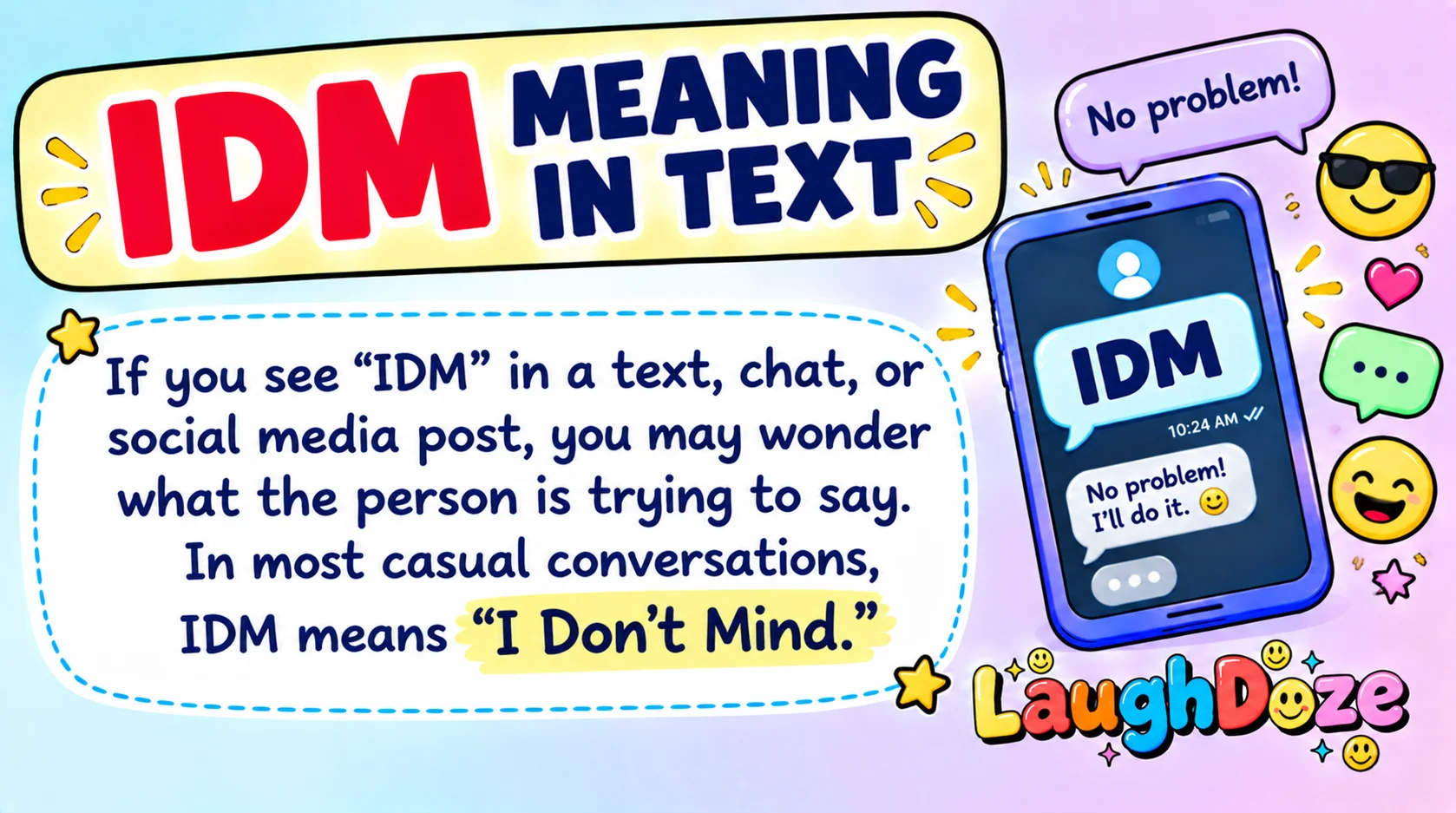
If you see “IDM” in a text, chat, or social media post, you may wonder what the person is trying to say. In most casual conversations, IDM means “I Don’t Mind.” People use it to show that they are okay with a suggestion, choice, plan, or situation.
For example, if someone asks, “Want to watch a movie or play a game?” you might reply, “IDM 😊.”
People often search for the IDM meaning in text because abbreviations can have different meanings depending on the conversation.
You may see IDM in texting, WhatsApp, Instagram, Snapchat, TikTok, gaming chats, and online comments.
In this guide, you’ll learn what IDM means, how people use it, when it sounds natural, how to reply, and what other meanings IDM can have.
What Does IDM Mean in Text & Chat?
In texting and online chat, IDM usually means “I Don’t Mind.”
It is a casual way to say:
- I’m okay with it.
- Either option is fine with me.
- I have no problem with that.
- I don’t have a preference.
- That works for me.
For example:
“Do you want pizza or burgers?”
“IDM, you choose 😂”
Here, the person is saying they are happy with either choice.
The exact tone depends on the conversation. IDM can sound relaxed, neutral, friendly, or slightly indifferent. It usually does not mean the person is upset.
Full Form, Stands For & Short Meaning of IDM
The most common texting full form of IDM is:
IDM = I Don’t Mind
| Abbreviation | Full Form | Short Meaning |
|---|---|---|
| IDM | I Don’t Mind | I’m okay with it |
| IDM? | I Don’t Mind? | Usually asks or responds about having no preference |
Unlike some slang terms, IDM is simply an abbreviation made from the first letters of “I Don’t Mind.”
For example:
“IDM where we eat.”
This means:
“I don’t mind where we eat.”
It is generally informal and is more common in casual digital communication than in formal writing.
Origin, History & First Known Use of IDM
There is no single, clearly documented moment when IDM became a texting abbreviation. It developed naturally from the broader habit of shortening common phrases in digital communication.
As texting, instant messaging, forums, and social media became popular, users began turning frequently used phrases into quick abbreviations. Expressions such as “I don’t mind” are easy to shorten because the first letters create a compact three-letter form.
Today, IDM can appear in everyday texts, group chats, gaming conversations, comments, and direct messages.
It is worth noting that IDM can also have unrelated meanings outside casual texting, so the surrounding context matters.
How People Use IDM in Daily Conversations
People usually use IDM when they want to show that they have no strong preference.
Texting Examples
“Movie or dinner?”
“IDM, both sound good.”
“Movie or dinner?”
“IDM, both sound good.”
Friend: “Want tea or coffee?”
You: “IDM. You pick.”
Social Media Usage
On social media, IDM can appear in:
- Direct messages
- Comments
- Group conversations
- Gaming chats
- Community discussions
- Casual replies
Someone might write:
“IDM if you post it.”
That usually means:
“I don’t mind if you post it.”
Casual Situations
IDM works especially well when someone gives you a choice.
“Movie or dinner?”
“IDM, both sound good.”
It can also mean that something does not bother you:
“Is it okay if I sit here?”
“Yeah, IDM.”
IDM Meaning Across WhatsApp, Instagram, TikTok & Snapchat
The meaning of IDM generally stays the same across major social platforms. It usually means “I Don’t Mind.”
IDM on WhatsApp
On WhatsApp, IDM is commonly used in private chats and group messages when someone wants to say they are fine with a suggestion.
“IDM, just let me know when you’re free.”
IDM on Instagram
On Instagram, you might see IDM in DMs or comments.
“IDM if you share the photo.”
The meaning is still “I don’t mind.”
IDM on TikTok
TikTok users may use IDM in comments or messages when responding casually to another person’s suggestion.
“IDM 😂 you can choose the sound.”
IDM on Snapchat
On Snapchat, IDM can be used in quick messages between friends.
“IDM, send it whenever.”
There is usually no special Snapchat-specific meaning. Context still determines the intended meaning.
Different Meanings of IDM in Other Fields
Although “I Don’t Mind” is the common meaning in texting, IDM can stand for other things in different contexts.
For example, in technology, IDM can refer to Internet Download Manager, a software application associated with downloading files.
In other professional or technical settings, IDM may be used as an abbreviation for different terms.
This is why context matters. If someone writes:
“I installed IDM on my PC.”
They are probably not saying “I Don’t Mind.” They may be referring to Internet Download Manager.
So, when you see IDM, first look at the surrounding words and the topic of the conversation.
Common Confusions, Mistakes & Wrong Interpretations
IDM is fairly simple, but a few misunderstandings are common.
1. Thinking IDM Means “I Don’t Know”
IDK means “I Don’t Know,” while IDM usually means “I Don’t Mind.”
These are completely different.
- IDK = I Don’t Know
- IDM = I Don’t Mind
2. Assuming IDM Is Always Indifferent
“I don’t mind” can sometimes sound uninterested, but that is not always the intention.
For example:
“Where should we eat?”
“IDM 😊”
This can simply mean the person trusts you to choose.
3. Confusing IDM With a Technical Term
If the conversation is about computers or downloading files, IDM may refer to Internet Download Manager rather than the texting phrase.
4. Reading Too Much Into a Short Reply
A response such as “IDM” is brief. It does not automatically mean someone is annoyed or uninterested. Their punctuation, emojis, and the rest of the conversation can provide more clues.
Similar Terms, Alternatives & Related Slang
| Term | Meaning | Usage |
|---|---|---|
| IDM | I Don’t Mind | Shows you are okay with something |
| IDK | I Don’t Know | Shows uncertainty or lack of knowledge |
| IDC | I Don’t Care | Shows lack of concern or preference |
| NBD | No Big Deal | Says something is not important |
| NP | No Problem | Says something is okay |
| TBH | To Be Honest | Introduces an honest opinion |
| IMO | In My Opinion | Introduces a personal view |
| WYD | What You Doing? | Asks what someone is doing |
| WTV | Whatever | Often shows indifference or acceptance |
One important distinction is between IDM and IDC. “I don’t mind” usually sounds softer than “I don’t care,” which can sometimes sound dismissive depending on context.
Examples of IDM in Real Chat Situations
Here are some natural ways people might use IDM in a conversation:
- “IDM, you can pick the restaurant 😂”
- “Want to meet Friday or Saturday?” “IDM 😊”
- “IDM if we watch another episode.”
- “Can I borrow your charger?” “Yeah, IDM.”
- “IDM where we sit 🤔”
- “I’m free tonight, IDM what we do.”
- “IDM if you bring your friend too.”
- “Tea or coffee?” “IDM, honestly 😂”
- “IDM, just send me the details later.”
- “Do you want to walk or take the bus?” “IDM.”
- “IDM if we start a little later 😊”
- “I really IDM which movie we watch.”
The meaning in each example is understood from the surrounding conversation.
How to Reply When Someone Says IDM
Your response depends on what the person is discussing.
Casual Reply
“Cool, you choose then 😊”
Friendly Reply
“Perfect! Let’s go with the first option.”
Funny Reply
“Excellent. The decision-making power is officially mine 😂”
If They Say “IDM” About Plans
“Okay, let’s meet at 7 then.”
If They Say “IDM” About Food
“Nice, I’m choosing pizza!”
Formal Alternative
If you need to respond in a professional setting, avoid abbreviations and say:
“Either option works for me.”
That sounds clearer and more appropriate for formal communication.
Is IDM Still Popular? Trends & Online Usage
IDM remains understandable and useful in casual online communication, especially when someone wants to quickly say they have no preference.
However, texting slang changes over time. Different age groups, platforms, and online communities may prefer different abbreviations. Some people may write the complete phrase “I don’t mind” instead of using IDM.
IDM is most natural in informal settings such as:
- Text messages
- Friend group chats
- Social media DMs
- Gaming conversations
- Casual online communities
It is less suitable for formal emails, business documents, academic writing, or professional messages.
Quick Facts About IDM
| Factor | Details |
|---|---|
| Meaning | I Don’t Mind |
| Category | Texting abbreviation |
| Tone | Casual, neutral, relaxed |
| Usage Platform | Texting, WhatsApp, Instagram, TikTok, Snapchat, chats |
| Popularity | Commonly understood in casual online communication |
| Formal/Informal | Informal |
| Main Purpose | Shows acceptance or lack of preference |
FAQs
What does IDM mean on Snapchat?
On Snapchat, IDM usually means “I Don’t Mind.” Someone may use it when they are okay with a suggestion or do not care which option you choose. For example, if you ask, “Should we talk now or later?” and they reply “IDM,” they are generally saying either choice is fine.
Is IDM rude?
IDM is not normally rude. It usually means “I Don’t Mind” and can be a simple way to show that something is okay. However, a very short “IDM” without an emoji or additional context could sound a little detached to some people. Tone depends heavily on the conversation and relationship.
What does IDM mean from a girl?
If a girl sends “IDM,” it generally means “I Don’t Mind,” just as it does for anyone else. She may be saying that she has no preference or is comfortable with your suggestion. The abbreviation itself does not indicate romantic interest, annoyance, or any particular feeling.
What does IDM mean from a guy?
If a guy texts “IDM,” it usually means “I Don’t Mind.” He may be saying that either choice works for him or that something does not bother him. The meaning should be understood from the topic of the conversation rather than assuming the abbreviation has a special meaning based on gender.
What does IDM mean in a text message?
In a text message, IDM most commonly means “I Don’t Mind.” It is used when someone is comfortable with a choice, suggestion, or situation. For example, “Do you want pizza?” followed by “IDM” means the person does not have a strong preference about what you eat.
What is the difference between IDM and IDK?
IDM means “I Don’t Mind,” while IDK means “I Don’t Know.” IDM communicates acceptance or a lack of preference. IDK communicates uncertainty or a lack of knowledge. For example, “Which movie should we watch? IDM” means either movie is fine, while “IDK” means the person does not know which movie to choose.
What is the difference between IDM and IDC?
IDM means “I Don’t Mind,” while IDC means “I Don’t Care.” IDM generally sounds more neutral or accepting. IDC can sound stronger and, depending on the context, may come across as dismissive. For polite casual communication, “IDM” often feels softer than “IDC.”
Can IDM mean something other than “I Don’t Mind”?
Yes. IDM can have different meanings in technical or professional contexts. For example, in a computer-related conversation, IDM can refer to Internet Download Manager. The correct meaning depends on the words around it and the subject being discussed.
Conclusion
The most common IDM meaning in text is “I Don’t Mind.” It is a short, informal expression used to show that someone is okay with a suggestion, does not have a strong preference, or is comfortable with a situation.
You may see it in text messages, WhatsApp chats, Instagram DMs, Snapchat conversations, TikTok comments, gaming chats, and other casual online spaces.
IDM is generally neutral rather than rude, although the tone can change depending on the conversation.
It is also important not to confuse IDM with IDK (“I Don’t Know”) or IDC (“I Don’t Care”). In technology-related discussions, IDM can have a completely different meaning.
When you are unsure, check the surrounding context before interpreting the abbreviation.

Max Wilder is a humor writer on a mission to make the internet laugh one pun at a time.