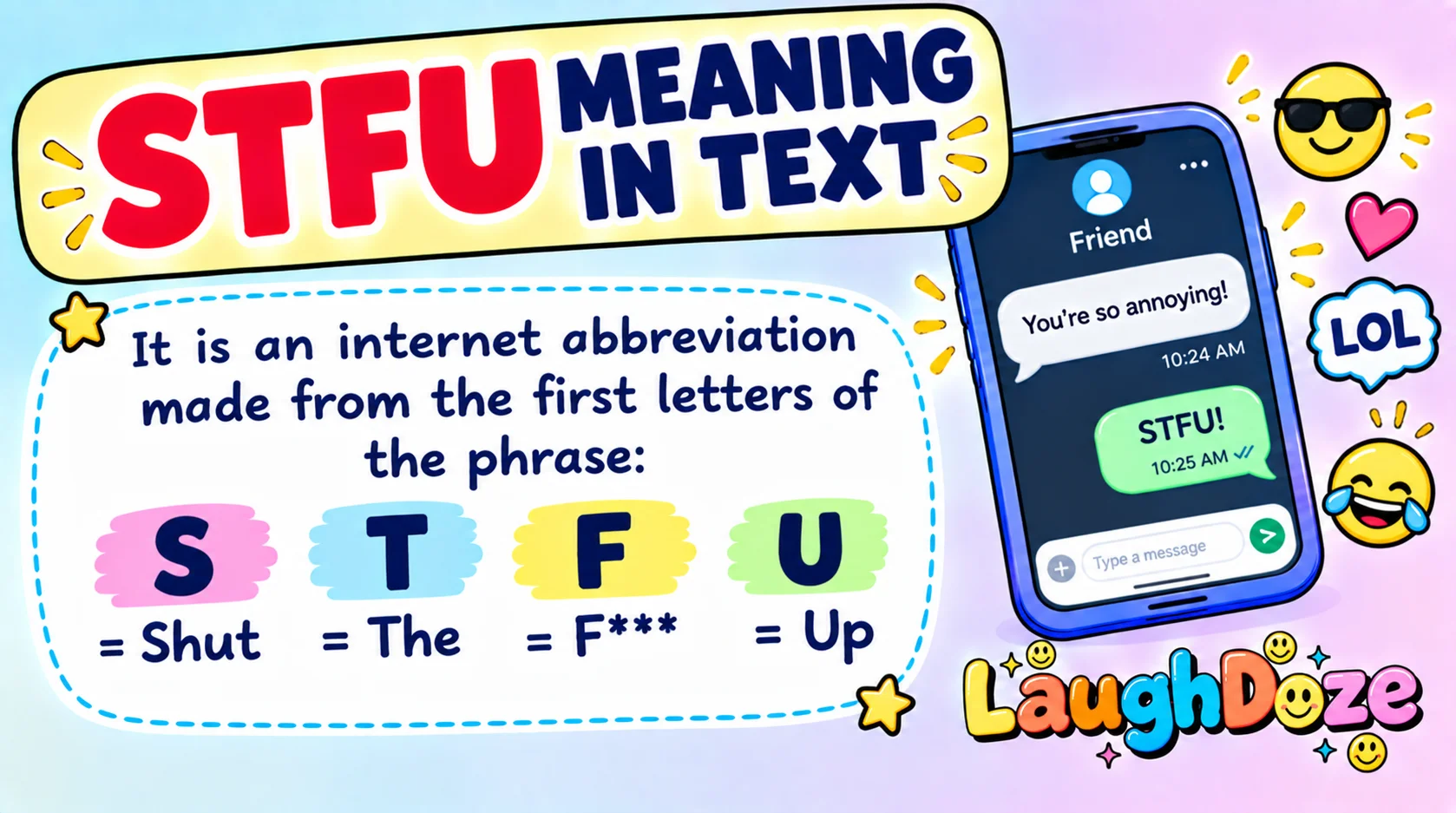
If you have seen “STFU” in a text, comment, or social media post, you may wonder what it means and whether it is meant as a joke or an insult. STFU means “shut the f* up.”** It is a blunt slang expression telling someone to stop talking, usually in a rude, angry, or teasing way.
You may see it in texting, group chats, gaming, memes, TikTok comments, Instagram posts, and other casual online conversations.
The meaning can change with the relationship and tone between the people using it.
In this guide, you’ll learn what STFU meaning in text is, where the slang comes from, how people use it, whether it is offensive, and how to respond when someone sends it to you.
What Does STFU Mean in Text & Chat?
STFU means “shut the f* up” in text messages and online chat.**
It is an internet abbreviation made from the first letters of the phrase:
- S = Shut
- T = The
- F = F***
- U = Up
The phrase is usually used to tell someone to be quiet. However, the tone depends heavily on context.
For example:
“STFU, you actually got tickets? 😂”
Here, the sender may be joking because they are surprised.
But:
“STFU. I’m done arguing with you.”
This sounds angry and confrontational.
Because the full phrase contains profanity, STFU is considered informal and potentially offensive. It is generally better suited to casual conversations than professional, school, or formal settings.
Full Form, Stands For & Short Meaning of STFU
The full form of STFU is “shut the f* up.”**
In simple words, it means:
“Be quiet” or “stop talking,” but in a much stronger and more vulgar way.
STFU can communicate different emotions:
- Anger
- Annoyance
- Shock
- Disbelief
- Playful teasing
- Excitement or surprise
The surrounding message is important. Friends may use STFU jokingly, while the same abbreviation from a stranger can sound hostile.
There is no separate official or formal expansion of STFU. It is a slang abbreviation formed from the phrase itself.
Origin, History & First Known Use of STFU
STFU developed from the phrase “shut the f* up,”** which existed as spoken profanity long before internet slang became common.
The abbreviation became popular as digital communication grew. Early online communities, chat rooms, forums, instant messaging, and gaming helped spread short expressions such as STFU, LOL, BRB, and OMG.
Using the initials made it faster to type while also softening the visual impact of writing the complete swear word. Later, STFU became common across social media, memes, gaming chats, and text messages.
Today, it is widely recognizable internet slang, although its use is still strongly informal.
How People Use STFU in Daily Conversations
People usually use STFU when they want someone to stop talking or when reacting strongly to something another person has said.
In texting
“STFU 😂 You did not actually say that.”
This could be playful between close friends.
In a group chat
“STFU, I just checked and you were right.”
The sender may be expressing surprise rather than genuine anger.
On social media
“STFU 😭 This video is too funny.”
Here, STFU can be used as exaggerated internet humor.
In an argument
“STFU and listen for a second.”
This is much more aggressive and should not be treated as friendly slang.
The relationship between the people, punctuation, emojis, and surrounding words can all change the tone.
STFU Meaning Across WhatsApp, Instagram, TikTok & Snapchat
The basic meaning of STFU stays the same across major social platforms, but the way people use it can vary.
STFU on WhatsApp
On WhatsApp, STFU commonly appears in private chats and group conversations. Friends may use it jokingly, especially when reacting to surprising news or playful teasing.
STFU on Instagram
Instagram users may use STFU in comments, DMs, captions, or reactions. In comments, it can be either humorous or insulting depending on the conversation.
STFU on TikTok
TikTok has helped make many slang terms part of fast-moving online humor. STFU can appear in comments as an exaggerated reaction to a video, joke, story, or surprising moment.
STFU on Snapchat
On Snapchat, STFU is usually casual and conversational. Friends might use it while joking around or reacting to something unexpected.
The abbreviation does not have a different basic definition on these platforms. The context determines whether it sounds playful, annoyed, or aggressive.
Different Meanings of STFU in Other Fields
Unlike some abbreviations, STFU has one dominant meaning in internet slang: “shut the f* up.”**
However, abbreviations can sometimes have unrelated meanings in specialized settings. If you encounter STFU in a technical, business, academic, or organizational document, the surrounding context should be checked before assuming it refers to internet slang.
In everyday texting and social media, though, the slang meaning is by far the one most people expect.
Common Confusions, Mistakes & Wrong Interpretations
STFU is easy to recognize, but people can misunderstand its tone.
Mistake 1: Assuming it is always serious
Not every use of STFU is an actual demand for silence. Close friends may use it as playful exaggeration.
Mistake 2: Thinking it is polite
It is not. Even when used jokingly, STFU contains profanity and can offend someone who does not share that style of humor.
Mistake 3: Ignoring context
“STFU 😂” and “STFU.” can feel very different. Emojis, punctuation, and the conversation before it can provide useful clues.
Mistake 4: Using it in professional communication
STFU is not appropriate for most workplace emails, customer messages, formal discussions, or academic communication.
Similar Terms, Alternatives & Related Slang
| Term | Meaning | Usage |
|---|---|---|
| STFU | Shut the f*** up | Strong, informal, sometimes joking |
| Shut up | Stop talking | Informal and can be rude |
| Be quiet | Stop making noise or talking | More neutral |
| Zip it | Be quiet | Casual and often playful |
| Shush | Be quiet | Mild and informal |
| LOL | Laughing out loud | Shows amusement |
| OMG | Oh my God | Shows surprise or excitement |
| WTF | What the f*** | Shows shock, confusion, or anger |
| GTFO | Get the f*** out | Very informal and aggressive |
| SMH | Shaking my head | Shows disappointment or disbelief |
Examples of STFU in Real Chat Situations
Here are some realistic ways STFU may appear in online conversations:
- “STFU 😂 You really wore that to the party?”
- “STFU, no way you won the competition! 😭”
- “Bro, STFU and let me finish the story. 😂”
- “STFU 😊 I already know you’re joking.”
- “Wait… STFU. Did she actually say yes? 🤔”
- “STFU 😂 That is the funniest thing I’ve heard all day.”
- “STFU, you’re making me laugh at work. 😭”
- “STFU 🤔 How did you even manage to do that?”
- “Okay, STFU for one second and listen to this. 😂”
- “STFU! You actually remembered my birthday? 😊”
Notice that the same abbreviation can sound friendly, shocked, funny, or aggressive depending on the situation.
How to Reply When Someone Says STFU
Your response should depend on the person’s tone and your relationship with them.
Casual reply
“😂 Okay, okay, I’ll stop.”
Funny reply
“You first. 😭”
Friendly reply
“Haha, relax! I’m just telling you what happened.”
If they seem angry
“I’m happy to talk, but please don’t speak to me like that.”
Polite or formal response
“I’d rather continue the conversation respectfully.”
If someone uses STFU toward you in a hostile way, you do not have to match their language. A calm response can prevent the conversation from becoming more heated.
Is STFU Still Popular? Trends & Online Usage
STFU remains recognizable and widely understood in online slang. It appears in text messages, memes, gaming conversations, social media comments, and casual chats.
Its popularity is partly due to how short and expressive it is. Four letters can communicate annoyance, disbelief, humor, or shock without typing the full phrase.
Younger internet users are especially likely to encounter abbreviations like STFU alongside other slang. However, recognition does not mean everyone considers it acceptable. Because it contains profanity, people often avoid it around coworkers, teachers, family members, or unfamiliar audiences.
Its exact frequency can change with online trends, but the abbreviation remains established internet slang.
Quick Facts About STFU
| Factor | Details |
|---|---|
| Meaning | Shut the f*** up |
| Category | Internet slang / texting abbreviation |
| Tone | Rude, aggressive, humorous, or teasing |
| Usage Platform | Texting, WhatsApp, Instagram, TikTok, Snapchat, gaming |
| Popularity | Widely recognized online slang |
| Formal/Informal | Highly informal |
| Profanity | Yes |
| Main Purpose | Telling someone to stop talking or expressing strong reaction |
FAQs
What does STFU mean on Snapchat?
On Snapchat, STFU means “shut the f* up.”** Friends may use it as a joke, a reaction to surprising news, or a genuine request for someone to stop talking. The abbreviation itself does not change on Snapchat, so the surrounding message and relationship help determine whether it is playful or offensive.
Is STFU rude?
Yes, STFU is generally considered rude or offensive because it contains profanity and directly tells someone to be quiet. However, close friends sometimes use it jokingly without intending genuine hostility. If you are unsure how someone will react, phrases such as “be quiet” or “hold on” are safer alternatives.
What does STFU mean from a girl?
If a girl texts STFU, it normally has the same basic meaning: “shut the f* up.”** Her intention depends on context. She might be genuinely annoyed, joking with a friend, or reacting dramatically to surprising information. Her gender does not give the abbreviation a different meaning.
What does STFU mean from a guy?
If a guy sends STFU, it usually means “shut the f* up.”** The message can be serious, playful, sarcastic, or surprised depending on the conversation. Look at the words around STFU, emojis, punctuation, and your relationship with the person before deciding how seriously to take it.
Can STFU be used as a joke?
Yes. Friends sometimes use STFU jokingly when they are shocked, excited, or teasing each other. For example, someone might say, “STFU, you actually met my favorite actor? 😂” In that setting, the sender may not literally be demanding silence. Still, the phrase contains profanity and can easily be misunderstood.
Is STFU an insult?
STFU can function as an insult when it is directed at someone aggressively. However, it is not always intended as an insult. Online friends may use it as exaggerated humor or playful teasing. The difference usually comes from context, tone, and the relationship between the people involved.
Is STFU appropriate at work?
Generally, STFU is not appropriate for professional communication. It contains profanity and can sound disrespectful or hostile. In a workplace, alternatives such as “Could you please stop for a moment?” or “Let me finish my point” communicate the same basic idea without the offensive language.
What is a polite alternative to STFU?
Polite alternatives include “please be quiet,” “could you give me a moment?” “please let me finish,” or “can we pause for a second?” These phrases are much safer when speaking with coworkers, teachers, customers, older relatives, or people you do not know well.
Conclusion
Understanding STFU meaning in text is useful because the abbreviation can carry very different emotional tones. Its standard meaning is “shut the f* up,”** and it is commonly used in texting, social media, gaming, and other informal online conversations.
Sometimes it is a genuine command and can sound aggressive. At other times, friends use it as playful exaggeration when they are surprised or amused.
Context, emojis, punctuation, and the relationship between the speakers all matter. Because STFU contains profanity, it is best avoided in formal or professional settings.
If you are unsure about someone’s intention, look at the rest of the conversation rather than interpreting the abbreviation by itself.

Max Wilder is a humor writer on a mission to make the internet laugh one pun at a time.