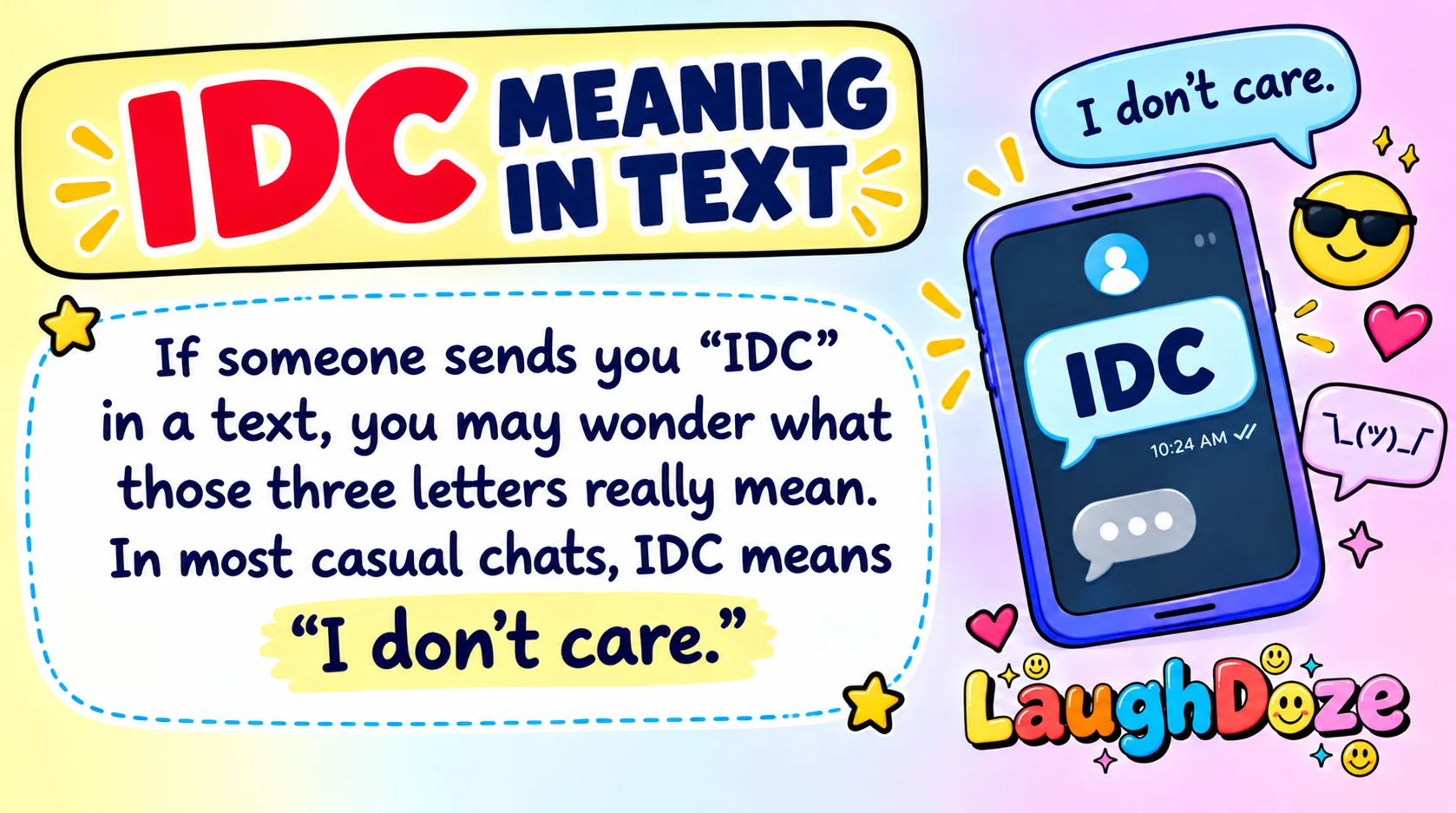
If someone sends you “IDC” in a text, you may wonder what those three letters really mean. In most casual chats, IDC means “I don’t care.” It is a common internet abbreviation used when someone wants to show that they have no strong preference, interest, or concern about something.
You may see it in text messages, group chats, comments, and social media conversations.
Depending on the situation, IDC can sound relaxed, neutral, annoyed, or even a little rude. That is why context matters.
In this guide, you’ll learn the IDC meaning in text, how people use it on popular apps, what it can mean in different situations, how to reply, and how it compares with similar slang such as “IDK,” “WTV,” and “NVM.”
What Does IDC Mean in Text & Chat?
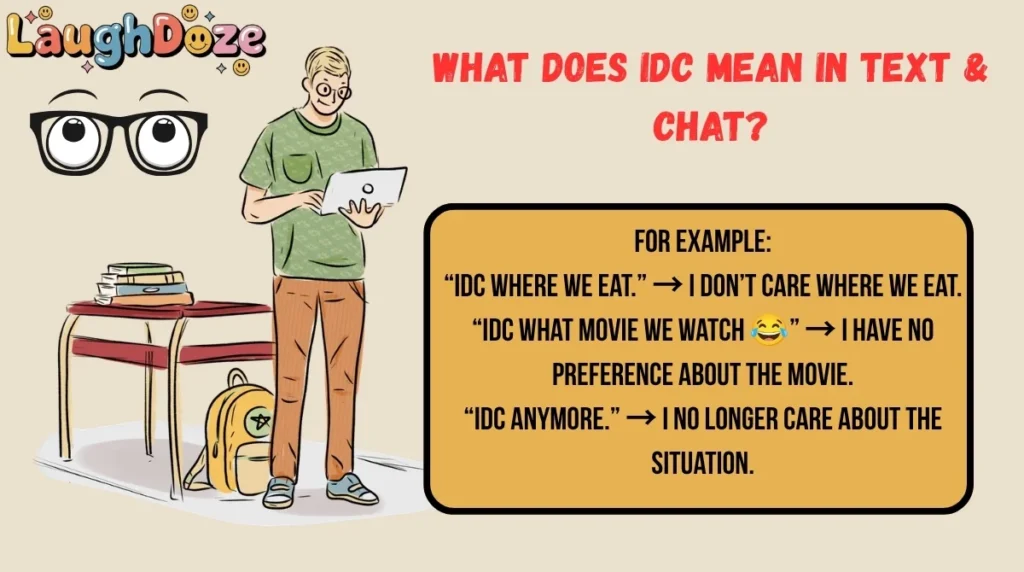
IDC means “I don’t care” in text and online chat.
People use it to say they do not have a preference or do not want to spend time discussing something.
For example:
- “IDC where we eat.” → I don’t care where we eat.
- “IDC what movie we watch 😂” → I have no preference about the movie.
- “IDC anymore.” → I no longer care about the situation.
The exact tone depends on the conversation. Among friends, IDC can be casual and harmless. During an argument, however, it may sound dismissive or cold.
Full Form, Stands For & Short Meaning of IDC
The standard full form of IDC in texting is:
IDC = I Don’t Care
| Form | Meaning |
|---|---|
| IDC | I Don’t Care |
| I | I |
| Don’t | Do not |
| Care | Care or have concern |
There is no need to treat IDC as a formal acronym. It is mainly an informal texting abbreviation and internet slang term.
Short Meaning of IDC
The simplest definition is:
IDC means “I don’t care” or “I have no preference.”
For example, if a friend asks, “Pizza or burgers?”, replying “IDC” can mean that either option is fine.
Origin, History & First Known Use of IDC
IDC developed as part of the wider growth of internet slang, chat abbreviations, and SMS-style communication. People began shortening common phrases to make online conversations faster and easier.
The phrase “I don’t care” was already common long before texting. IDC simply compresses it into three letters.
Like many online abbreviations, it became easier to use as instant messaging, texting, forums, and social media became part of everyday communication. Today, people may use IDC in everything from private messages to comments and group chats.
There is not one universally agreed person or event that can be credited with creating IDC. It belongs to the broader tradition of shortening everyday phrases online.
How People Use IDC in Daily Conversations
People use IDC in several ways. The meaning stays close to “I don’t care,” but the emotion behind it can change.
1. Showing No Preference
Someone may use IDC simply because either choice works.
Example:
“Do you want coffee or tea?”
“IDC, you choose.”
Here, IDC is not necessarily negative.
2. Showing Lack of Interest
A person might use it when they are not interested in a topic.
“They are arguing about the new update.”
“IDC about that stuff.”
3. Ending a Discussion
IDC can also signal that someone does not want to continue talking about something.
“You keep asking me about it.”
“IDC anymore.”
4. Showing Annoyance
In a tense conversation, IDC may sound like “I really don’t want to discuss this.”
“You should explain why you did that.”
“IDC.”
The short reply can feel much harsher than the same words written in a longer sentence.
IDC Meaning Across WhatsApp, Instagram, TikTok & Snapchat
The basic meaning of IDC usually stays the same across major social platforms.
IDC on WhatsApp
On WhatsApp, IDC is commonly used in private chats and group conversations.
Example:
“What time should we leave?”
“IDC, whenever you guys are ready.”
It can be casual and friendly when the context is relaxed.
IDC on Instagram
On Instagram, you may see IDC in DMs, comments, captions, or replies.
For example:
“IDC what anyone says 😂”
Here, the person may be emphasizing that other people’s opinions do not matter to them.
IDC on TikTok
TikTok users may use IDC in comments, messages, or captions. It can appear alongside other internet slang and may be used humorously.
“IDC, this song is still amazing 😂”
IDC on Snapchat
On Snapchat, IDC is often used in quick conversations because Snapchat messages tend to be informal and short.
“Where are we going?”
“IDC 😭 you pick.”
The platform does not normally change the core definition. Context and tone matter more than the app itself.
Different Meanings of IDC in Other Fields
Although “I Don’t Care” is the most common meaning in texting, IDC can stand for different things outside casual online communication.
For example, IDC can appear as an abbreviation for organizations, technical terms, business names, or industry-specific phrases.
However, if you receive IDC in a normal text message, DM, or social media chat, “I don’t care” is usually the intended meaning.
Always consider the surrounding words before choosing an alternative definition.
Common Confusions, Mistakes & Wrong Interpretations
IDC Does Not Usually Mean “I Don’t Know”
A common mistake is confusing IDC with IDK.
- IDC = I Don’t Care
- IDK = I Don’t Know
Compare:
“What time is the movie?”
“IDK.” → I don’t know.
Versus:
“What time should we go?”
“IDC.” → I don’t care; you decide.
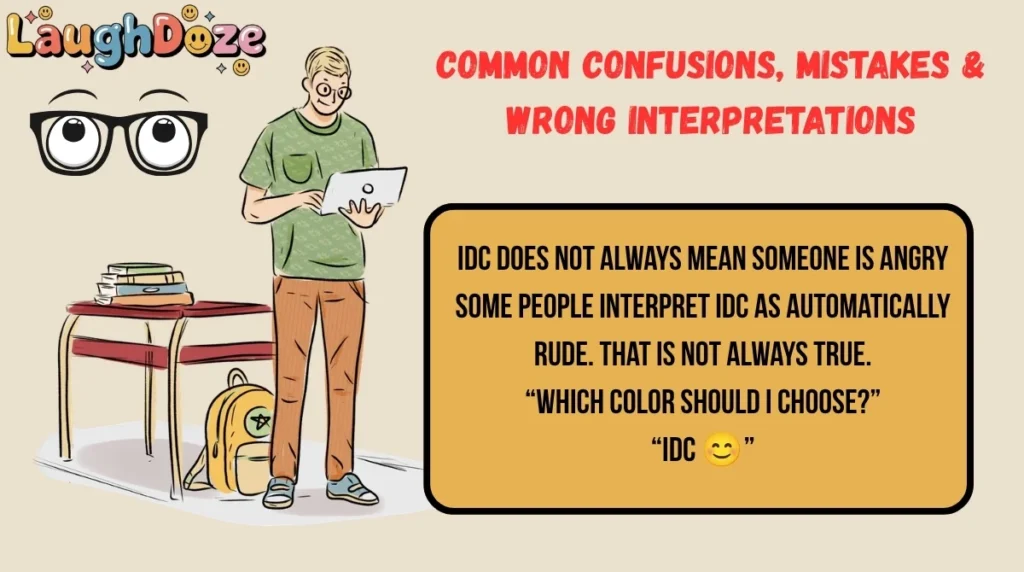
IDC Does Not Always Mean Someone Is Angry
Some people interpret IDC as automatically rude. That is not always true.
“Which color should I choose?”
“IDC 😊”
This can simply mean, “Either one is fine.”
Capital Letters Do Not Always Mean Anger
People often write slang in uppercase because that is the standard form of the abbreviation. IDC does not automatically mean the sender is shouting.
The surrounding message gives you a better clue about the tone.
Similar Terms, Alternatives & Related Slang
| Term | Meaning | Usage |
|---|---|---|
| IDC | I Don’t Care | Shows no concern or preference |
| IDK | I Don’t Know | Shows uncertainty or lack of knowledge |
| WTV | Whatever | Shows indifference or dismissal |
| NVM | Never Mind | Drops or withdraws a topic |
| IDGAF | I Don’t Give A F*** | Stronger, more vulgar version of indifference |
| IKR | I Know, Right? | Shows agreement |
| TBH | To Be Honest | Introduces an honest opinion |
| IMO | In My Opinion | Introduces a personal view |
The closest everyday alternatives to IDC are “whatever,” “doesn’t matter,” “I’m fine either way,” and “you choose.”
Examples of IDC in Real Chat Situations
Here are some natural examples showing how IDC can work in different contexts:
- “Do you want pizza or tacos?” — “IDC, you pick 😂”
- “IDC what we watch tonight 😊”
- “Are you mad at me?” — “IDC 🤔”
- “IDC who goes first. Just start.”
- “What color should I buy?” — “IDC, both look good.”
- “IDC anymore, honestly.”
- “You can choose the restaurant. IDC 😂”
- “IDC what they think about my outfit.”
- “Should we go today or tomorrow?” — “IDC.”
- “IDC, just tell me what happened 🤔”
- “I IDC about that game 😂”
- “IDC where we meet. Just send me the location.”
Notice that the same abbreviation can feel friendly, neutral, frustrated, or dismissive depending on the conversation.
How to Reply When Someone Says IDC
Your response should depend on what the person seems to mean.
Casual Reply
“Okay, you choose then 😂”
Friendly Reply
“Fair enough! I’ll decide 😊”
Funny Reply
“Perfect. The decision has officially been transferred to me 😂”
If They Sound Annoyed
“No worries. I just wanted to know what you preferred.”
If You Want a Clear Answer
“Either is fine, or do you actually have a preference?”
Formal Reply
In a professional conversation, it is better to avoid matching the slang. You could say:
“Understood. I’ll make the decision based on what works best.”
Is IDC Still Popular? Trends & Online Usage
IDC remains a recognizable and widely understood texting abbreviation, especially in informal digital communication.
It is most natural in:
- Text messages
- Group chats
- DMs
- Social media comments
- Gaming chats
- Casual conversations
Its popularity is connected to the continued use of short-form internet language. However, how often an individual uses IDC depends on their age, social group, platform, and communication style.
Younger internet users may mix IDC with newer slang, emojis, abbreviations, and memes. Older users who regularly text or use social media may also recognize it easily.
The important point is that IDC is informal language, so it generally does not belong in formal emails, academic writing, or professional documents.
Quick Facts About IDC
| Factor | Details |
|---|---|
| Meaning | I Don’t Care |
| Category | Texting abbreviation / internet slang |
| Tone | Casual; can be neutral, dismissive, or annoyed |
| Usage Platform | Texting, WhatsApp, Instagram, TikTok, Snapchat, DMs |
| Popularity | Common and widely recognized |
| Formal/Informal | Informal |
FAQs
What does IDC mean on Snapchat?
On Snapchat, IDC usually means “I Don’t Care.” Someone may use it when they have no preference or do not want to discuss a subject. For example, if a friend asks what you want to eat and you reply “IDC,” you are saying that you are happy for them to choose.
Is IDC rude?
IDC is not automatically rude, but it can sound dismissive depending on the situation. “IDC 😊” between friends may simply mean “either option is fine.” A one-word “IDC” during an argument can feel cold or uncaring. Tone, punctuation, emojis, and the relationship between the people all help determine the intended meaning.
What does IDC mean from a girl?
If a girl sends IDC, it generally means “I Don’t Care.” It does not have a special meaning simply because a girl uses it. She might be saying she has no preference, is uninterested in the topic, or does not want to continue the discussion. Look at the surrounding conversation to understand her specific intent.
What does IDC mean from a guy?
When a guy says IDC, it normally has the same basic meaning: “I Don’t Care.” Depending on the conversation, he could mean “you choose,” “it doesn’t matter to me,” or “I don’t want to talk about this.” The abbreviation itself does not indicate a particular romantic or personal meaning.
What is the difference between IDC and IDK?
IDC means “I Don’t Care,” while IDK means “I Don’t Know.” IDC describes a lack of concern or preference. IDK describes a lack of knowledge or certainty. For example, “IDC where we go” means any place is fine, while “IDK where we go” means the person does not know the destination.
What does IDC mean in a relationship?
In a relationship conversation, IDC can have different emotional tones. It may mean that someone genuinely has no preference, but it can also sound dismissive if used during a disagreement. The abbreviation alone cannot tell you what the person feels. Consider the full conversation and how they normally communicate.
What does IDC mean in a text from a friend?
When a friend texts IDC, they may simply mean that they have no preference. For example, “What should we order?” followed by “IDC” can mean “You decide.” If the conversation is tense, however, IDC might signal frustration or a desire to stop discussing the subject.
What does IDC mean in social media comments?
In social media comments, IDC generally means “I Don’t Care.” People may use it to show that another person’s opinion, trend, criticism, or topic does not matter to them. The phrase can be playful or dismissive depending on the post and the surrounding comments.
Conclusion
Understanding IDC meaning in text is simple: it usually stands for “I Don’t Care.” People use this abbreviation when they have no preference, feel uninterested, or want to show that something does not matter to them.
You can find it in texts, WhatsApp chats, Instagram DMs, TikTok comments, Snapchat messages, and other informal online conversations. Still, the abbreviation does not always carry the same emotional tone.
A friendly “IDC 😂” may simply mean “you choose,” while a short “IDC” during an argument can sound dismissive.
The safest way to understand it is to look at the complete conversation and the relationship between the people involved.
Also remember the key difference: IDC means “I Don’t Care,” while IDK means “I Don’t Know.”

Max Wilder is a humor writer on a mission to make the internet laugh one pun at a time.