Have you ever read a text and thought, “What does this person really mean?” That is where decoding meaning in text comes in. Decoding means interpreting a message so you can understand the information, intention, tone, or idea behind it.
In texting, this can involve looking at the words, emojis, punctuation, abbreviations, timing, and the conversation around the message.
People search for the decoding meaning in text because online conversations can be short, unclear, or easy to misunderstand.
A simple “Okay,” for example, can sound friendly, neutral, annoyed, or uncertain depending on the situation.
In this guide, you will learn what decoding means, how it works in chats and social media, common examples, related terms, and how to interpret messages without jumping to conclusions.
What Does Decoding Meaning in Text & Chat Mean?
Decoding meaning in text means interpreting a written message to understand what the sender is communicating. It can involve understanding the literal words as well as the context, symbols, slang, emojis, and possible intention behind them.
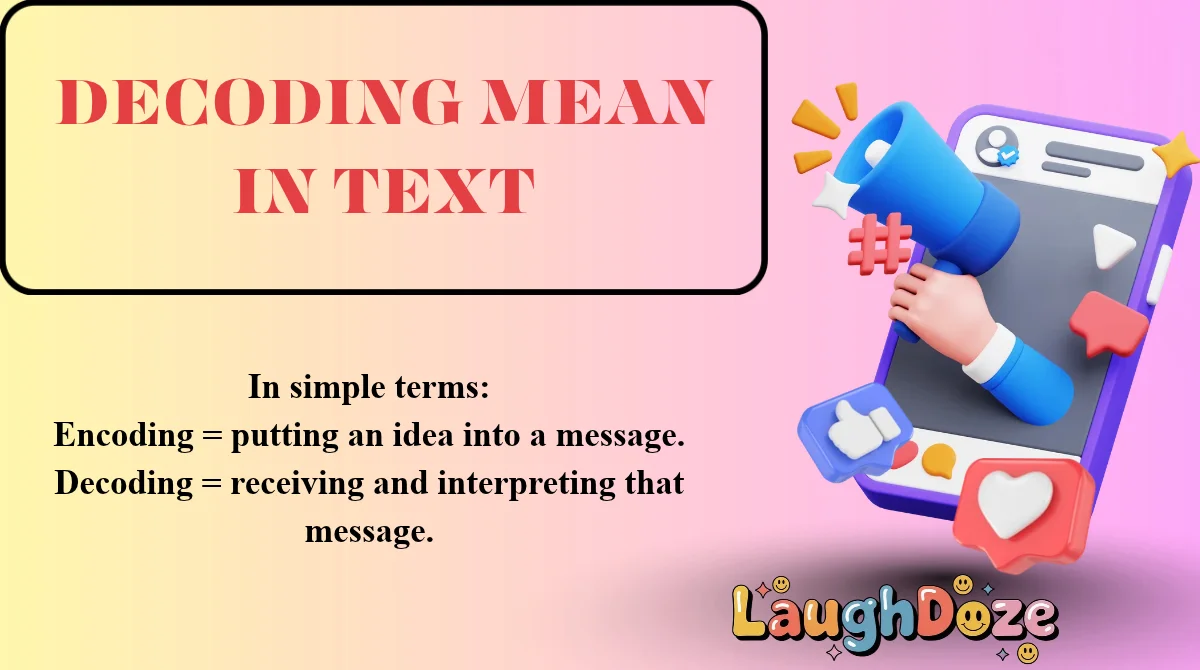
In simple terms:
Encoding = putting an idea into a message.
Decoding = receiving and interpreting that message.
Communication models commonly describe the sender as encoding an idea into symbols or language and the receiver as decoding those symbols to create meaning.
For example:
Person A: “Sure…”
The literal word is “sure.” However, the three dots may make the message feel different from:
Person A: “Sure! 😊”
The first message might sound uncertain or hesitant in some contexts, while the second may appear more cheerful. Still, punctuation and emojis do not have one fixed meaning. The conversation and relationship matter.
That is why decoding a text is not simply translating words. It is about understanding the message as a whole.
Full Form, Stands For & Short Meaning of Decoding
Decoding is not an acronym, so it does not have a traditional “full form” like LOL, BRB, or IDK.
The short meaning is:
Decoding = interpreting or understanding a message.
The word comes from decode, which means to discover the meaning of information that may be coded, complicated, or difficult to understand.
In texting, people may use “decoding” casually when they are trying to figure out what another person meant.
For example:
- “I’m decoding her text right now.”
- “Can you help me decode this message?”
- “I need to decode what he meant by that.”
- “We spent ten minutes decoding that group chat.”
Here, “decode” does not necessarily mean breaking a secret code. It can simply mean working out the intended meaning.
Origin, History & First Known Use of Decoding
The idea of decoding is closely connected to codes, symbols, language, and communication. Dictionaries define decode as converting coded information into an understandable form or finding the meaning of something that is difficult to understand.
Dictionary.com records decode as first recorded around 1895–1900, formed from de- and code.
The concept later became important in fields such as communication, linguistics, information processing, and computing. In communication, decoding describes the receiver’s process of interpreting a message.
Today, the word is also common in everyday digital communication. People may say they are “decoding” a text when a message seems vague, indirect, emotional, or difficult to interpret.
How People Use Decoding in Daily Conversations
People commonly use decoding when a message is not completely clear.
In Texting
A friend might send:
“Do whatever you want.”
You understand the words, but you may wonder whether the person is genuinely giving you freedom or expressing frustration.
You might say:
“I’m trying to decode what ‘do whatever you want’ actually means 😂”
In Dating Conversations
People sometimes use “decode” when discussing short or ambiguous replies.
For example:
“He just replied ‘haha’ after my message. I’m trying to decode it.”
The person is trying to understand whether “haha” shows genuine amusement, politeness, nervousness, or simply a quick response.
In Group Chats
Decoding can also mean figuring out slang, inside jokes, abbreviations, or references that not everyone understands.
“Someone decode this group chat for me 🤔”
In Everyday Situations
The word can be used outside texting too:
- “I can’t decode his handwriting.”
- “She is trying to decode the instructions.”
- “We had to decode the clues.”
- “Can you decode what this email means?”
So, the basic idea stays the same: turning unclear information into understandable meaning.
Decoding Meaning Across WhatsApp, Instagram, TikTok & Snapchat
The basic meaning of decoding does not change between social media platforms. However, the type of message being decoded can vary.
On WhatsApp, decoding may involve:
- Short replies
- Emojis
- Voice-note context
- Group-chat jokes
- Abbreviations
- Message timing
- Punctuation
For example:
“Fine.”
A person might wonder why the sender used a period instead of simply saying “fine,” but the punctuation alone does not prove a particular emotion.
On Instagram, decoding can involve:
- Comments
- DMs
- Captions
- Story replies
- Emojis
- Likes and reactions
A comment such as “Interesting 👀” could be interpreted in different ways depending on the post and conversation.
TikTok
TikTok often uses slang, trends, memes, sounds, and phrases that may have meanings specific to an online community.
Decoding a TikTok comment may therefore require understanding the trend or reference behind it.
Snapchat
On Snapchat, people may decode:
- Short chat messages
- Snaps with captions
- Emojis
- Inside jokes
- Abbreviations
- Reactions
The platform does not give “decoding” a special meaning. It is simply the process of interpreting the communication.
Different Meanings of Decoding in Other Fields
The word decoding has several uses beyond texting.
Communication
In communication, decoding is the process through which the receiver interprets a message and attaches meaning to it.
Linguistics
In language learning, decoding can involve understanding words, phrases, or sentences and extracting their meaning. Cambridge specifically notes this use in relation to understanding language.
Computing
In computing, decoding can mean converting coded data into another usable or understandable form.
Cryptography
In a security or code-related setting, decoding may refer to turning coded information back into readable information. This is more technical than the casual texting use.
Education
Teachers may use the term when talking about reading skills. Decoding can involve connecting written symbols with sounds and words.
So, the exact meaning depends on the field, but the central idea remains extracting or interpreting meaning from information.
Common Confusions, Mistakes & Wrong Interpretations
Decoding a message does not mean that your interpretation is automatically correct.
This is one of the most important things to remember.
Mistake 1: Taking Every Short Reply Personally
A reply such as:
“K”
might feel cold to one person. But the sender could simply be busy or typing quickly.
Mistake 2: Treating Emojis as Fixed Codes
An emoji can have different meanings depending on the conversation, age group, relationship, and platform.
Mistake 3: Ignoring Context
The same phrase can mean different things in different situations.
For example:
“Nice.”
Could be sincere praise, sarcasm, or a simple acknowledgment.
Mistake 4: Assuming Hidden Meaning
Not every text contains a secret message. Sometimes “okay” simply means okay.
Mistake 5: Overanalyzing Punctuation
A period, exclamation mark, or ellipsis can affect how a message feels, but punctuation alone is not enough to prove someone’s intention.
Good decoding uses context instead of guessing.
Similar Terms, Alternatives & Related Slang
| Term | Meaning | Usage |
|---|---|---|
| Decode | Understand or interpret information | Messages, codes, language |
| Interpret | Explain or understand meaning | Text, speech, behavior |
| Understand | Grasp the meaning of something | Everyday communication |
| Decipher | Work out something difficult or unclear | Codes, writing, messages |
| Analyze | Examine something carefully | Texts, conversations, information |
| Translate | Change words from one language to another | Languages |
| Clarify | Make something easier to understand | Conversations and writing |
| Read between the lines | Look for implied meaning | Indirect messages |
| Figure out | Find the answer or meaning | Casual conversation |
| Explain | Make an idea clear | Everyday and professional settings |
Examples of Decoding Meaning in Real Chat Situations
Here are realistic examples of how people may use “decoding” in conversations:
- “Can you help me decode this text? I have no idea what she means 😂”
- “I’m still decoding his ‘sure…’ from yesterday.” 🤔
- “Wait, let me decode that message before I reply.” 😊
- “Someone please decode this TikTok comment for me 😂”
- “I had to decode all the abbreviations in our group chat.”
- “She sent ‘interesting 👀’ and now I’m trying to decode it.” 🤔
- “Why are we decoding a two-word text like it’s a secret document? 😂”
- “I think you’re over-decoding that message. He probably just meant okay.”
- “Can you decode what ‘we’ll see’ means in this context?” 🤔
- “I need a professional decoder for this group chat 😂.”
- “After reading the whole conversation, I finally decoded what he was saying.” 😊
- “Don’t decode the emoji alone. Look at the whole conversation.”
These examples show that “decoding” is usually informal when used in everyday chat.
How to Reply When Someone Says “Decoding”
If someone says they are decoding your message, your reply can depend on the situation.
Casual Reply
“Haha, what part are you trying to decode? 😂”
Funny Reply
“There is no secret code. You’re overthinking it 😂”
Friendly Reply
“Just ask me if it’s confusing. I’ll explain 😊”
Playful Reply
“Good luck, detective. 🤔😂”
Direct Reply
“I meant exactly what I said.”
Formal Reply
In a professional conversation, you could say:
“If anything was unclear, I’m happy to clarify.”
The best response usually depends on whether the person is joking, genuinely confused, or asking for clarification.
Is Decoding Still Popular? Trends & Online Usage
Decoding remains a normal English word, but its use in casual internet conversations is broader than its traditional code-related meaning.
People may use “decode” or “decoding” when talking about:
- Text messages
- Internet slang
- Dating conversations
- Emojis
- Memes
- Social media comments
- Vague replies
- Workplace messages
- Group chats
Digital communication creates many situations where people must interpret short written messages. Communication research and educational resources also use decoding as a standard term for the receiver’s interpretation of a message.
However, there is no special slang definition of “decoding” that applies only to one platform. It remains an ordinary English word used in a more casual way online.
Quick Facts About Decoding Meaning in Text
| Factor | Details |
|---|---|
| Meaning | Interpreting or understanding a message |
| Category | English word / communication term |
| Tone | Usually neutral or casual |
| Usage Platform | Texting, WhatsApp, Instagram, TikTok, Snapchat, email, social media |
| Popularity | Common English vocabulary |
| Formal/Informal | Both; casual online use is common |
| Acronym? | No |
| Basic Opposite | Encoding |
| Related Words | Interpret, understand, decipher, analyze |
Frequently Asked Questions
What does decoding mean in text messages?
Decoding in text messages means trying to understand what a written message means. This can include the literal words, context, punctuation, emojis, slang, and surrounding conversation. For example, if someone sends a vague reply, you may “decode” it by considering what was discussed before and what the sender may be communicating.
What does decoding mean on Snapchat?
On Snapchat, decoding simply means interpreting a message, caption, emoji, or snap to understand what the sender means. It does not have a special Snapchat-only definition. Someone might say they are “decoding” a Snap when the message is vague, uses slang, or seems to contain an implied meaning.
Is decoding a slang word?
No. Decoding is a standard English word, not an acronym or slang term. Its traditional meaning involves interpreting coded or difficult information. Online, people often use it casually to describe trying to understand the meaning behind someone’s text, comment, emoji, or social media message.
Is decoding rude?
No, the word decoding is not inherently rude. The tone depends on how it is used. Saying “I’m decoding this message 😂” can be playful, while repeatedly saying someone needs to be decoded could sound critical. Context, relationship, and wording determine whether the expression feels friendly or negative.
What does decoding mean from a girl?
If a girl says she is “decoding” a text, she usually means she is trying to understand what a message means or what the sender intended. It does not automatically indicate romantic interest, suspicion, or another specific emotion. The surrounding conversation is needed to understand what she means.
What does decoding mean from a guy?
If a guy says he is “decoding” a message, he generally means he is trying to work out its meaning or intention. It could refer to slang, an unclear reply, an emoji, or an indirect statement. The word itself does not reveal a particular feeling or relationship.
What is the difference between encoding and decoding?
Encoding is putting an idea into a message using words, symbols, sounds, or other forms of communication. Decoding is the receiver’s process of interpreting that message. In simple terms, the sender encodes the idea, while the receiver decodes it. Communication models commonly use these terms together.
Does decoding mean reading between the lines?
Sometimes, but not always. Decoding has a broader meaning: it is the process of understanding information or a message. “Reading between the lines” specifically means looking for an implied or unstated meaning. Therefore, reading between the lines can be part of decoding, but decoding does not always involve hidden meaning.
Why is decoding important in texting?
Decoding matters because written messages often provide less information about tone than face-to-face conversations. A short phrase can be interpreted in several ways depending on context. Looking at the complete conversation, rather than one word or emoji alone, can help reduce misunderstandings.
Conclusion
Decoding meaning in text is simply the process of interpreting a written message so you can understand what it communicates. In everyday texting, people may use the word when they are trying to figure out the meaning behind a short reply, emoji, abbreviation, joke, or vague statement.
The key point is that decoding is not the same as guessing. Context matters. The sender’s words, the previous conversation, punctuation, emojis, and communication style can all provide useful clues, but none should automatically be treated as proof of hidden intent.
Whether you are using WhatsApp, Instagram, TikTok, Snapchat, email, or ordinary text messages, the basic idea stays the same: decoding helps turn written signals into understandable meaning.
It is a normal part of modern communication and an important skill for avoiding unnecessary misunderstandings.

Max Wilder is a humor writer on a mission to make the internet laugh one pun at a time.